

Research
Excited State Dynamics and Photophysics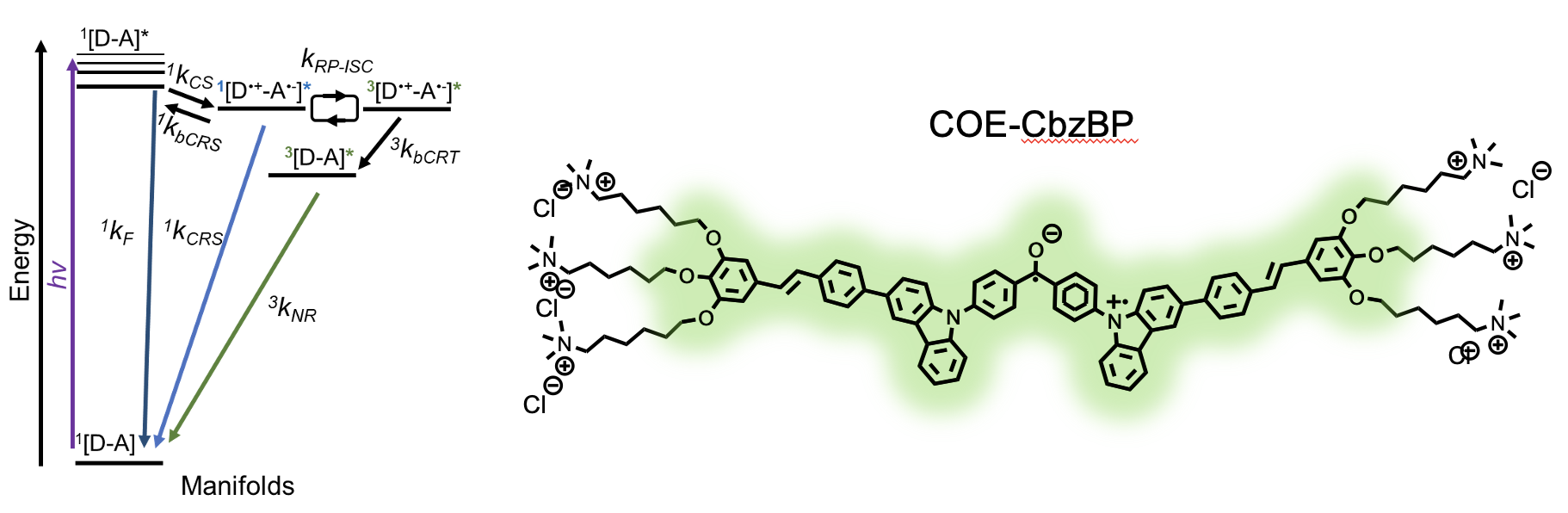
Triplet-state production and management through molecular design are essential yet minimally understood aspects in organic photophysics. We are working on this challenge by developing water-soluble twisted intramolecular charge transfer (TICT) chromophores with a partial break in its π-conjugation, yielding a near-isoenergetic singlet-triplet energy gap (∆EST ~ 0 eV). In some cases, photoinduced electron transfer can occur upon excitation, resulting in a spin-correlated radical pair (SCRP) sensitive to electric and magnetic field effects. By combining design, synthesis, and time-resolved spectroscopy, and non-linear optics, novel organic materials are tailored and optimized for their use in biological imaging and sensing, quantum information science (QIS), organic light-emitting diodes (OLEDs), photovoltaics (PVs), energy transfer, and catalysis, and other emerging applications.
Open-Shell Conjugated Polyelectrolytes
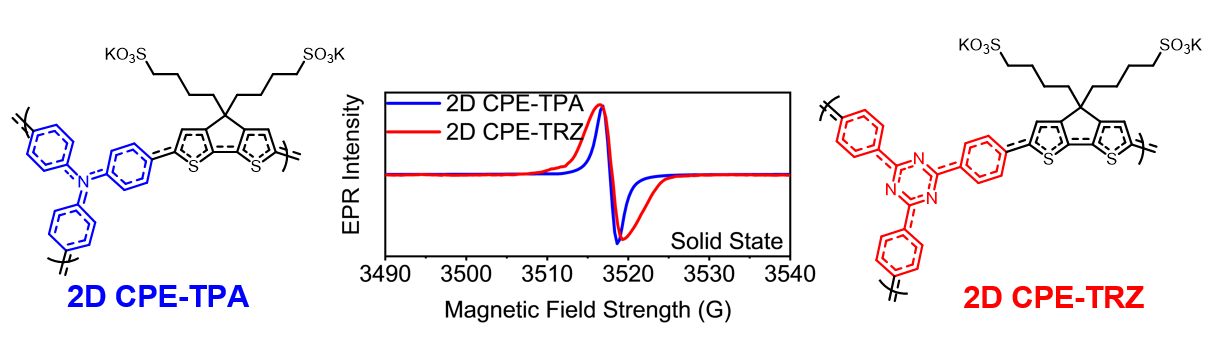
Efficient ion-electron conduction and its management are essential yet poorly understood properties in one-dimensional (1D) and two-dimensional (2D) conjugated polyelectrolytes (CPEs). CPEs possess the backbone of traditional conjugated polymers with ionic functionalities as sidechains. We are working on developing such materials with open-shell character (stable unpair electrons) for energy transduction and magnetic applications in the aqueous phase. By combining design, synthesis, and electrochemical methods, novel CPEs are tailored and optimized for their use in green energy storage, bioelectrosynthesis, quantum information sciences (QIS), and other emerging applications.
Optical Probes and Technique Development for Biophysical Interrogation

Precision in life science is an analytical chemistry problem. Concerning biological imaging, sensing, and nanoparticle analysis, current instrument development is focused on using traditional fluorescent dyes to “shed light” on long-standing biological problems. In addition, conventional instrumentation focuses on bulk biological analysis. The Vázquez Lab is combining state-of-the-art dye design with biological characterization techniques to develop unique instrumentation capable of interrogating biological nanoparticles at the single entity level, focusing on fluorescence lifetime as the analytical signal instead of fluorescence intensity.